
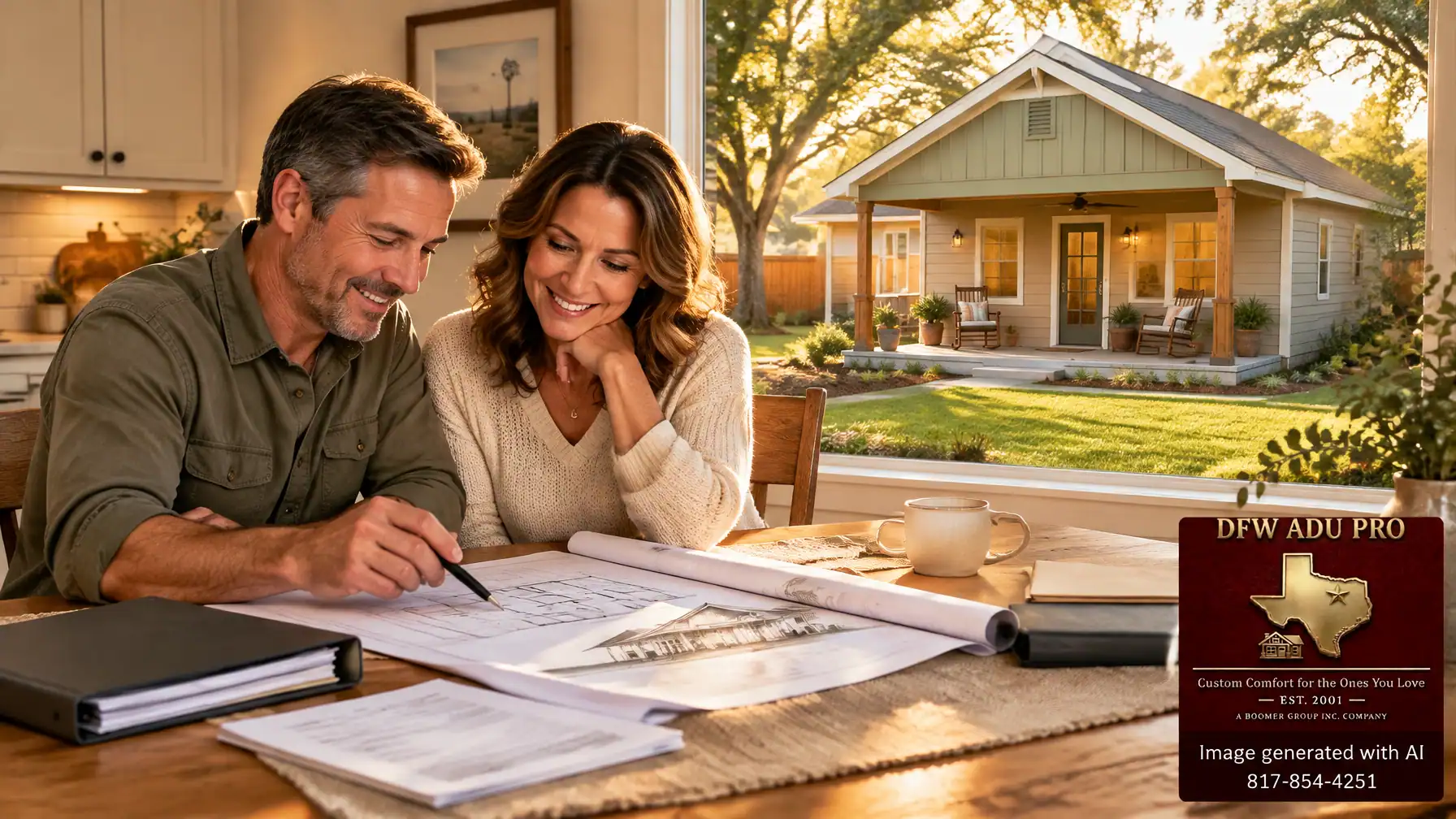
Financing a Guest House deserves an early place in any guest house (ADU) plan. The way you fund construction can affect your budget, timeline, and how much flexibility you have if the project scope changes. It can also shape the conversations you’ll have with your lender, builder, and city.
For North Texas homeowners, common Paths include using home equity, arranging construction financing, or paying from savings. Each has different trade-offs, and no single option fits every family. The right starting point is a realistic understanding of what your property can support and what the project is expected to cost.
As a planning benchmark, 500 sq. ft. plans commonly begin around $125,000–$150,000. Total project costs vary based on site conditions, utilities, foundation, size, and finish level. That makes early feasibility and a well-defined scope important before you compare adu loans or adu construction financing.

Main financing paths North Texas homeowners explore
The options below are general descriptions, not financial advice. Ask your lender or financial advisor how a particular option applies to your circumstances.
Home equity loan
A home equity loan generally provides a lump sum secured by your home. Homeowners may explore it when they have a defined project scope and want to know the amount they’re borrowing upfront.
The trade-off is that payments and terms depend on the lender and the loan agreement, and borrowing against your home carries risk. Ask how the lender evaluates available equity, what fees apply, and whether its requirements fit a construction project.
HELOC
A home equity line of credit (HELOC) is a revolving credit line secured by your home. It may suit a project where funds are needed in stages, but the amount available and how withdrawals work are lender-specific.
The flexibility can be helpful, but terms may change and borrowing may involve variable payments. Ask the lender about the draw period, repayment structure, fees, and what happens if project costs or timing shift.
Cash-out refinance
A cash-out refinance replaces an existing mortgage with a new one and may provide funds for construction, subject to lender approval and applicable requirements.
Because the new loan replaces the existing mortgage, compare the full terms and costs, not just the amount available for the guest house. This approach may not be attractive for every homeowner, particularly if changing the current mortgage is a concern.
Construction loan
Construction financing may be structured around project costs and staged payments as work progresses. A lender may ask for plans, a construction budget, contractor information, permits, and a draw schedule before deciding whether the project qualifies.
This route can involve detailed documentation, inspections, and lender controls over how funds are released. Ask how the loan handles construction timing, cost changes, and the transition after the build.
Personal savings
Some homeowners use savings to cover part or all of a project. This avoids applying for a loan, but it’s still important to understand the complete project budget and preserve adequate funds for other needs.
Discuss your personal financial situation with an appropriate advisor before deciding how much to commit.
Builder-arranged or Third-party financing
Some builders may provide information about financing resources or direct homeowners to third-party providers. Availability, terms, and eligibility depend on the provider, not the builder.
Confirm who is providing the financing, review the terms directly with them, and don’t assume a referral means a loan will be approved or is the right choice for you.
Comparing the options
| Path | Typical use case | How it works at a high level | Key considerations |
|---|---|---|---|
| Home equity loan | A homeowner exploring a lump sum for a defined scope | Borrow funds secured by home equity | Lender requirements, fees, payment terms, and risk to the home |
| HELOC | A project with staged funding needs | Access a credit line as permitted by the lender | Draw and repayment rules, potential payment changes, and fees |
| Cash-out refinance | A homeowner considering a new mortgage to access funds | Replaces the current mortgage and may provide construction funds | Review the full new loan terms and costs |
| Construction loan | A project needing controlled, staged payments | Lender evaluates plans, budget, contractor, and draw process | Documentation, inspections, timeline, and funding conditions |
| Personal savings | A homeowner choosing to use available funds | Pay project expenses without a loan | Overall budget and personal reserves |
| Third-party financing | A homeowner exploring a provider introduced by a builder or another source | Apply directly with an independent provider | Verify provider, eligibility, terms, and any fees |
What lenders commonly look at
Lender requirements differ, but homeowners may be asked about:
- Home equity: The lender may review the property value, existing mortgage, and other obligations tied to the home.
- Credit profile and income: A lender assesses its own credit, income, and repayment requirements.
- Debt-to-income: Existing obligations and income may be considered when evaluating ability to repay.
- Project scope and documents: Plans, a detailed proposal, budget, construction timeline, permits, contractor details, and a draw schedule may be requested.
For a guest house (ADU), project clarity matters. Requirements can vary by lender, borrower, and property, so ask what documentation is needed before relying on a particular financing path.
Why a defined turnkey contract can help
A clearly written fixed-price (GMP) turnkey contract, when available for a project, can make lender conversations more organized by giving homeowners a defined scope and cost framework to discuss. It can help everyone understand what the proposed work includes and how construction, permitting, and project coordination fit together.
Review the contract carefully. Ask what is included, what may be excluded, how allowances or contingencies are handled, and what could change the price. The contract can support a lender discussion, but it does not guarantee financing or lender acceptance.

A practical sequence for planning financing
- Start with feasibility. Confirm that the lot, local requirements, utilities, and intended use can support the project before investing heavily in final plans.
- Define a realistic scope and budget. Understand the expected size, foundation, site work, utilities, finishes, and other project components.
- Review the proposed contract. If a fixed-price (GMP) turnkey contract is available, clarify its terms and documentation.
- Speak with lenders. Share the scope and ask what financing paths and documents they require. Compare the terms directly with the lender or a financial advisor.
- Coordinate before construction begins. Confirm that financing, permits, construction documents, and the project schedule are aligned.
For homeowners exploring guest house builders Keller TX or other nearby communities, local requirements are part of the feasibility conversation, not an afterthought.
Frequently asked questions
Can I finance a guest house (ADU)?
Homeowners commonly explore home equity loans, HELOCs, cash-out refinancing, construction loans, savings, and third-party financing. Whether you qualify, and which path is appropriate, depends on the lender and your circumstances.
What do lenders typically look for?
A lender may review home equity, credit profile, income, debt-to-income, and project documentation such as plans, budget, contractor details, permits, and construction schedule. Requirements vary.
How does a fixed-price contract help?
It can provide a defined scope and cost framework to discuss with a lender. The lender decides what documentation it accepts, and a contract does not guarantee approval.
Does DFW ADU Pro offer financing?
DFW ADU Pro is not a lender and does not guarantee financing. We can help homeowners understand project scope and prepare for lender conversations. For more detail, see our Financing a Guest House.
What is the first step?
Start by discussing your property and goals with an experienced builder. A feasibility review can help identify project questions to resolve before you approach lenders.
Plan your project with a clear starting point
DFW ADU Pro, a division of Boomer Group Inc., has been building in Tarrant, Denton, and Wise counties since 2001. Our turnkey solutions include feasibility, design, full permit management, and construction, with slab foundations and architectural matching planned to help a guest house feel like a lasting part of your home. Our PRO Construction affiliate ranks in the top 1% of Texas contractors based on verified permit history.
Whether you’re planning an in-law suite, granny flat, backyard cottage, or a place that supports multigenerational living, our team can help you understand the construction side before you choose a financing path. Explore our services, learn more about financing for guest house projects, or request an estimate.
For North Texas project questions, call 817-854-4251 or email info@dfwadupro.com.
Financing disclaimer: Financing options, terms, and eligibility vary by lender and borrower. DFW ADU Pro is not a lender and does not guarantee financing. Verify financing details directly with your lender or financial advisor. Local zoning, permitting, HOA covenants, lot requirements, setbacks, utilities, and occupancy rules must be verified before quoting specifics.

A division of Boomer Group Inc.