
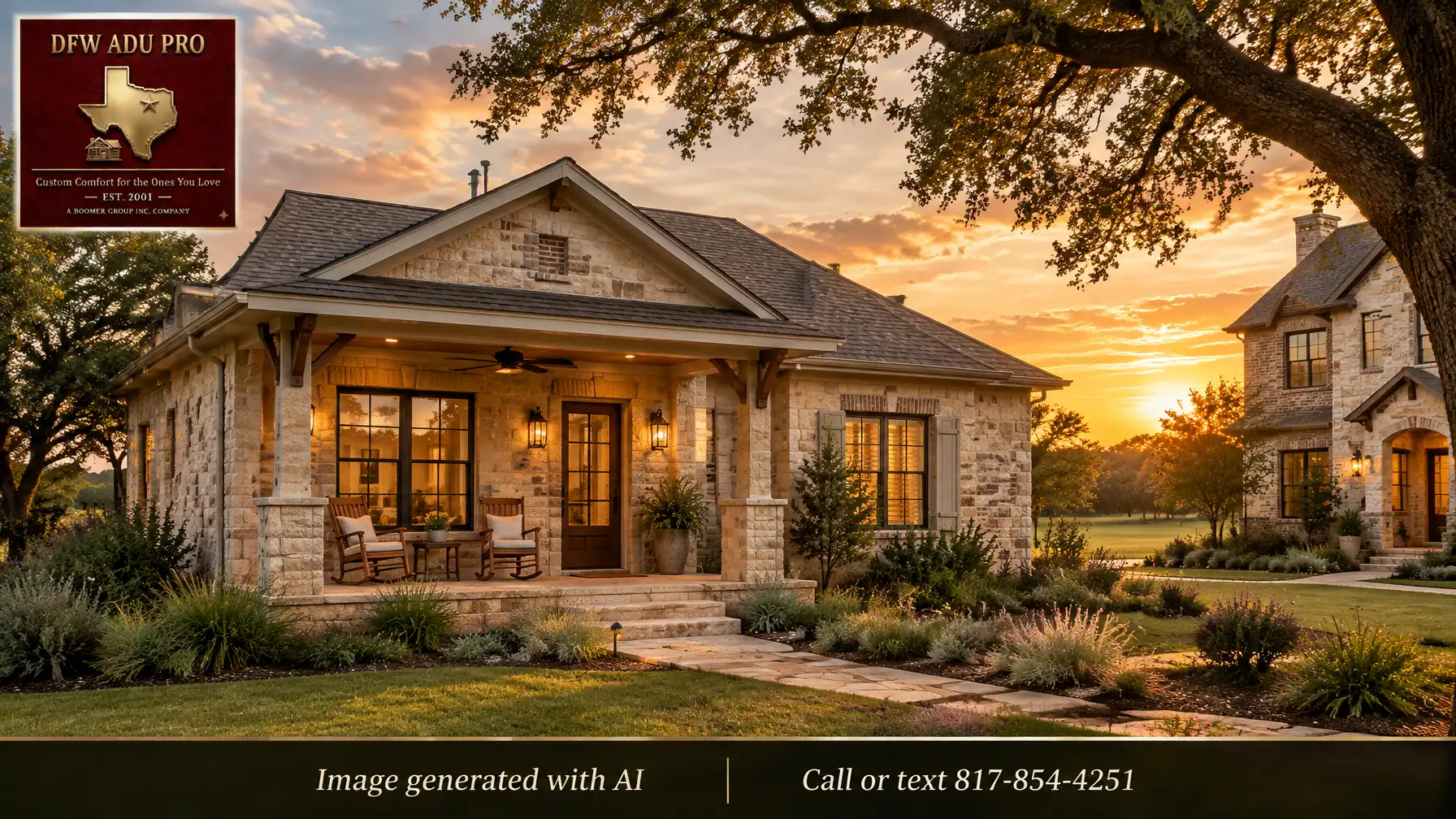
In Southlake, Westlake, Colleyville, and nearby North Texas communities, a guest house should feel like it belongs on the property, not like a separate building added after the fact. Masonry is one of the strongest ways to create that sense of continuity. But the choice is rarely as simple as “limestone or brick.”
Limestone brings a calm, substantial presence. Reclaimed brick adds color, age, and character. Used together with care, they can create a guest house that feels like a natural companion to the main home while serving a very real family purpose: giving an aging parent a private place nearby, or making room for another generation without giving up the neighborhood you love.

Start with the home you have, not a sample board
Before choosing individual stones or bricks, look at the main house from the guest house’s future vantage point. What materials dominate? Is the exterior mostly warm brick, pale limestone, or a combination? Are the mortar joints light and crisp, or do they blend into the masonry? What colors appear in the roof, trim, windows, and landscape?
The goal isn’t to make a smaller copy of the house. It’s to give the new structure a compatible palette, scale, and architectural character. Repeating one or two recognizable materials, perhaps the same limestone at the entry and a related brick tone on a side elevation, can establish a connection without making the guest house feel overly formal.
That restraint matters on a larger Southlake or Westlake homesite, where a detached structure may be seen from several angles. A composed design can support the impression of a cohesive, well-planned property. It cannot promise a particular increase in resale value, but thoughtful material coordination can contribute to the home’s overall presentation and long-term appeal.
Limestone: a quiet, substantial foundation for the design
Warm Texas limestone (buff, cream, or softly gray) can give a guest house a grounded, enduring look. It works particularly well on a stone-forward home, but it can also be an effective accent on a brick residence.
Consider where it will do the most visual work:
- Entry surround: A limestone-framed door can make the entrance feel deliberate and welcoming.
- Base or water table: A masonry base can visually anchor the structure.
- Porch columns: Stone columns create a substantial transition to a covered outdoor space.
- Selected gable or chimney detail: A small, carefully placed accent can echo the main home without overwhelming the smaller building.
Limestone varies in color, texture, and finish. A regular cut stone can feel formal and tailored; a more textured selection may feel relaxed and regional. Take samples outdoors and view them in direct sun, shade, and after wetting. North Texas light changes how warm or cool a pale stone reads.
Limestone is also porous, so detailing matters. Roof runoff, sills, caps, and ledges should be considered in the design. Ask the project team how water will be directed away from the masonry and how the selected stone should be maintained.
Reclaimed brick: character with a story
Reclaimed brick can bring a softer, more layered quality to a new guest house. Its appeal is in variation: weathered reds, smoky browns, muted gray notes, and the subtle differences that give a wall visual depth.
On a traditional, English-influenced, or transitional home, that patina may feel especially at home. On a more contemporary property, reclaimed brick can add warmth as a limited accent (perhaps at a garden-facing wall, entry volume, or small wing) rather than covering every elevation.
The important thing is to review a representative range, not one appealing sample. Reclaimed materials can vary in color, size, condition, and availability. Before selecting them, confirm that the chosen units are appropriate for the intended exterior use and that enough material is available for the entire project, including a reasonable allowance for cuts and future repairs. A mason should also evaluate how the pieces will course together and what mortar color and joint profile will best complement them.
Brick performance depends on assembly as well as appearance. Flashing, drainage, and other water-management details should be addressed as part of the design and construction plan. The Brick Industry Association’s guidance on water penetration resistance offers technical background on keeping masonry walls protected from moisture.

Four material approaches, and what they communicate
1. Limestone-forward
A limestone-forward exterior feels calm, cohesive, and substantial. It is often a natural fit when the main home already features pale stone. The key is matching the stone’s tone and texture closely enough to relate, while allowing some variation so the new building doesn’t look like an afterthought or an imitation.
2. Reclaimed-brick-forward
A brick-led exterior can feel established and warm, especially when its blend relates to brick already on the property. Match more than the general color: brick proportions, surface texture, mortar shade, and joint style all affect how close the relationship feels.
3. Brick with limestone accents
For many properties, this is the most flexible composition. Brick can provide the main field, with limestone reserved for the entry, columns, or base. Repeating the same balance found on the primary house, while simplifying some details, helps the guest house read as a companion structure.
4. Blended stone or masonry combinations
A blend of masonry colors or textures can add nuance, but too many competing patterns can make a modest-sized building feel visually busy. Choose a clear lead material and use the others with purpose. A full-scale sample or mock-up that combines the proposed masonry and mortar can help you judge the finished effect before construction begins.
Make the material work for family life
An exterior is part of the welcome. A shaded porch, a comfortable place to sit, and a clear path between buildings can help the guest house feel connected to family life while preserving privacy. Picture a grandparent on the porch watching the children play in the yard. That everyday scene is often the point: togetherness that doesn’t require everyone to share one front door.

The best design choices support that use. A covered porch with a ceiling fan, rocking chairs, and potted plants gives family members a place to visit outside the private living space. And when the guest house is planned for a parent who may have changing mobility needs, the layout and approach should be discussed alongside the exterior, not treated as separate decisions.
A guest house should also be built for lasting use. DFW ADU Pro emphasizes structural permanence, including slab foundations, and seamless architectural matching so the structure feels integrated with the main home.
Allow the material decision to inform the budget
The 500 sq. ft. plans commonly begin around $125,000–$150,000. This is a practical starting range, not a fixed quote. Total project cost varies with site conditions, utilities, foundation requirements, size, permitting, and finish level. Premium masonry selections and more elaborate luxury builds typically price above that range.
Masonry scope can affect both materials and labor. A thoughtful selection process (evaluating the full palette, confirming availability, and deciding where each material belongs) helps prevent expensive changes after work is underway.
For homeowners comparing project approaches, explore DFW ADU Pro’s services, or see our guest house builder information for Keller. We provide turnkey solutions that can include site feasibility, design, and full permit management. Our team handles the city submittal and inspection process, helping homeowners avoid having to navigate it on their own.
A good match is more than a close color
The right masonry choice is the one that fits the architecture, the homesite, and the way your family plans to use the space. Limestone may provide the quiet connection you’re after. Reclaimed brick may bring the warmth and history that suit your home. Or a disciplined combination of the two may offer the best balance.
DFW ADU Pro, a division of Boomer Group Inc., has served North Texas families since 2001, with work across Tarrant, Denton, and Wise counties and communities including Southlake, Westlake, Keller, Colleyville, and Grapevine. Our PRO Construction affiliate is ranked among the top 1% of Texas contractors based on verified permit history. We bring local experience, approachable craftsmanship, and turnkey project coordination to guest houses designed for the people you love.
Zoning and permit disclaimer: All zoning, permitting, and fee information must be verified directly with the local building or planning department before making decisions. HOA rules may also apply. Lot requirements, setbacks, utilities, occupancy rules, and other property-specific conditions should be verified before quoting project specifics.
To talk through your property and masonry goals, contact DFW ADU Pro, call or text 817-854-4251, or email info@dfwadupro.com. Visit dfwadupro.com.
A division of Boomer Group Inc.
Leave a Reply