
As we move through 2026, the conversation around North Texas real estate has shifted from "Can I build it?" to "How does it impact my long-term costs?" At DFW ADU Pro, a division of Boomer Group Inc., we have seen a massive surge in homeowners in Keller, Southlake, and throughout Denton and Wise counties seeking to add an accessory dwelling unit (ADU). Whether it’s to provide a dignified space for aging parents or to create a primary suite expansion that keeps the family together, the benefits are clear.
However, a question we often hear during our initial site feasibility consultations is: "What is this going to do to my property taxes?"
It is a sophisticated question that deserves a sophisticated answer. In North Texas, the property tax landscape is nuanced, particularly with recent reappraisal plans and the unique way the State of Texas treats "new improvements." As your expert partner in residential construction, we’ve broken down everything you need to know about navigating property tax assessments for your new guest house in 2026.
1. The Valuation Reality: Market Value vs. Assessed Value
The first thing every homeowner must understand is the distinction between what your home is worth on the open market and what the county appraisal district (CAD) says it is worth for tax purposes.
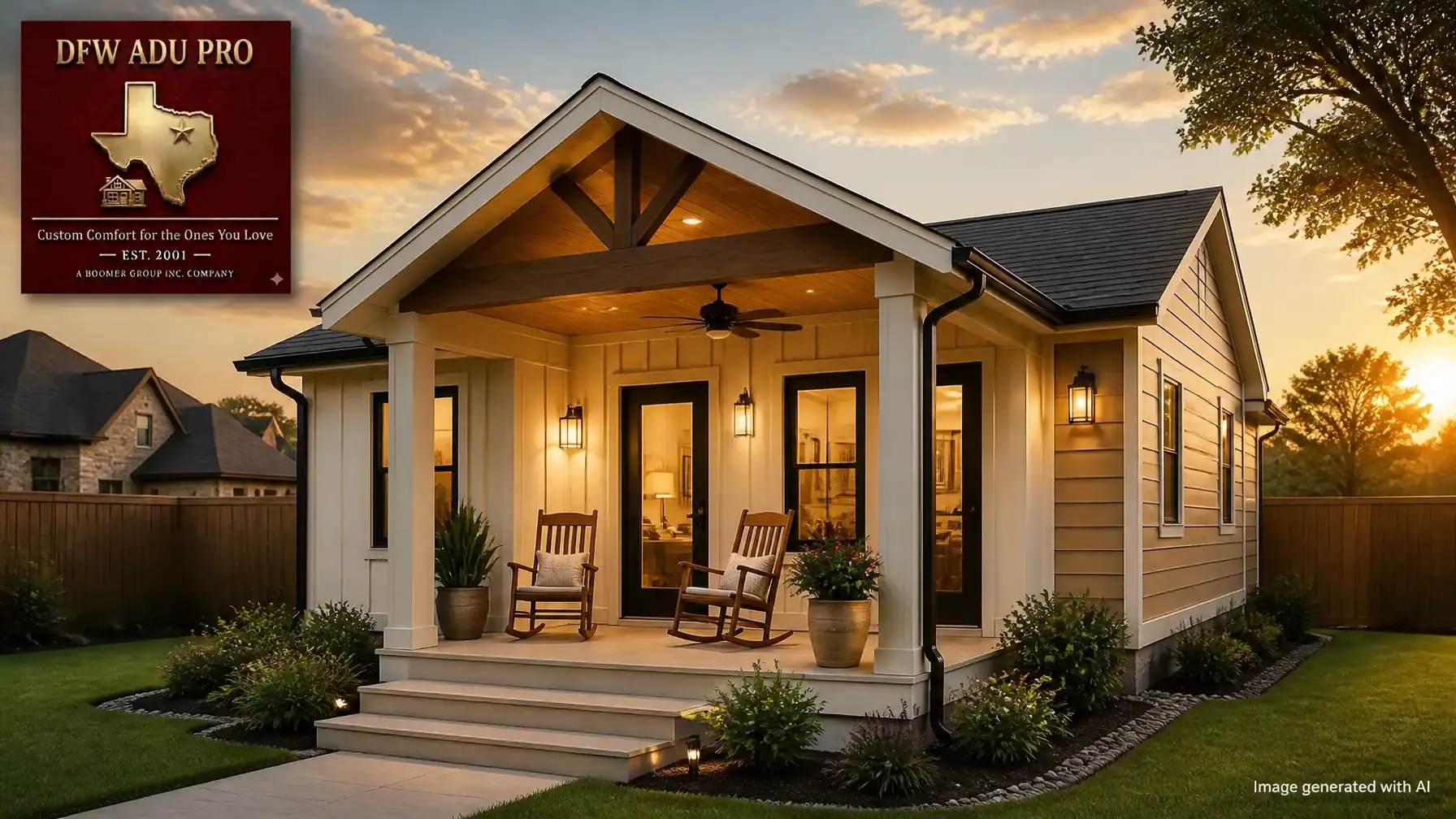
When you hire a premier adu builder to construct a detached guest house, you are undeniably increasing the market value of your property. A permanent, slab-on-grade ADU finished with high-quality Hardie board and batten siding and a functional front porch is a highly sought-after asset in the DFW market.
However, your tax bill is calculated based on the Assessed Value. In North Texas, the appraisal districts (TAD in Tarrant, DCAD in Denton, and WCAD in Wise) look at your property as a whole. An ADU is treated as a "new improvement" to the existing parcel. The district will assign a value to that new structure based on its square footage, construction quality, and use.
2. The Tarrant County "Freeze" Myth
If you live in Tarrant County, you may have heard headlines about a "reappraisal freeze" for the 2025 and 2026 tax years. While it is true that the Tarrant Appraisal District (TAD) has moved to a plan that generally holds residential values at 2024 levels to provide stability, there is a major caveat: new construction and major additions are the exceptions.
For homeowners in Keller or Southlake, this means that while the "base" value of your main home might stay flat, the addition of an ADU will trigger a new appraisal for that specific improvement. You cannot "hide" a new 500 sq. ft. guest house behind the freeze. Because we handle full permit management, the county will be notified of the new square footage, and it will be added to the tax roll at its full market value.

3. Decoding the 10% Homestead Cap
One of the most powerful protections for Texas homeowners is the 10% Appraisal Cap. Under the Texas Property Tax Code, the assessed value of your residence homestead cannot increase by more than 10% per year.
Here is the catch for ADU owners: The 10% cap applies to the property you already had on the books. It does not limit the value of "new improvements" in the year they are first added to the tax roll.
For example, if your home in Denton County is valued at $500,000 and you add a $150,000 ADU:
- Your existing $500,000 valuation is protected by the 10% cap.
- The $150,000 for the ADU is added in full as new construction.
- Your new assessed value would be roughly $650,000 (plus any allowed 10% increase on the original $500,000).
In subsequent years, the entire $650,000 becomes the new base, and the 10% cap will then apply to the total. This is why working with guest house builders in Keller, TX who understand the cost-to-value ratio is critical. You want to ensure the value added is accurately reflected, not inflated by the district.
4. Estimating Your 2026 Tax Bill
While every municipality has different tax rates, we can use the effective tax rates for our primary service areas to create a ballpark estimate. As of 2026, here is how the math typically shakes out for a new detached ADU:
- Tarrant County (Keller, Southlake, Fort Worth): With an effective rate of approximately 1.47%, a $150,000 ADU adds roughly $2,205 to your annual tax bill.
- Denton County (Flower Mound, Lewisville): At roughly 1.43%, that same ADU adds approximately $2,145 per year.
- Wise County (Decatur, Rhome): Known for being more tax-friendly with a 1.06% effective rate, you’re looking at about $1,590 annually.
When you compare this to the cost of an assisted living facility: which can easily exceed $5,000 to $7,000 per month: the tax impact of housing an elderly parent in an in-law suite is a remarkably efficient financial move.

5. Why Turnkey Permitting Matters for Your Valuation
There is a temptation for some homeowners to try and build "under the radar" to avoid tax increases. As a Top 1% ranked contractor in Texas, we strongly advise against this. An unpermitted ADU is a liability: it cannot be legally insured, it creates massive headaches during a future home sale, and it often results in the county appraising the structure at a "highest and best use" rate that may exceed its actual value once they eventually discover it.
When DFW ADU Pro handles your project, we manage the entire city submittal and inspection process. We ensure the ADU is classified correctly. A detached guest house cost in Keller usually falls between $125,000 and $150,000 for a 500 sq. ft. plan. By having a clear, permitted record of the construction, you have the documentation needed to protest your taxes if the county overestimates the value of the improvement.
6. Protesting Your 2026 Assessment
If you finish your ADU in 2025, you will see it on your April 2026 Notice of Appraised Value. If the number looks high, you have the right to protest.
- Deadline: Usually May 15, or 30 days after your notice is mailed.
- Evidence: Use your construction contract from DFW ADU Pro to show the actual cost of the "new improvement."
- Equity: Compare your ADU’s per-square-foot value to other multigenerational home additions in Keller.
We provide our clients with the necessary documentation to ensure their property is appraised fairly and accurately.

Conclusion: A High-Value Investment for North Texas Families
At the end of the day, property taxes are a sign of a growing investment. While the tax bill may increase slightly, the value of having your family close: and the massive increase in your property's equity: far outweighs the annual tax cost.
Our goal at DFW ADU Pro is to provide approachable craftsmanship that feels like a permanent, seamless extension of your home. We build with structural permanence (slab foundations) and timeless materials like Oklahoma Cream Hardie siding because we know these units aren't just "extra space": they are a legacy for your family.
Are you ready to explore the feasibility of an ADU on your property? Contact us today for a consultation. We’ll handle the permits, the construction, and the bureaucracy, so you can focus on what matters: the family waiting for that new front porch.
DFW ADU Pro
A division of Boomer Group Inc.
Leave a Reply