If you are a North Texas homeowner looking to house aging parents, create independent living space for a grown child, or add long-term value to your property, adding a backyard guest house is one of the smartest investments you can make. But before you fall in love with a floor plan or order custom finishes, there is a crucial reality every Tarrant County homeowner faces: there is no statewide ADU law in Texas.
Instead, every municipality writes its own rulebook. What flies smoothly in Fort Worth might require a rigorous public hearing and a Specific Use Permit (SUP) in Keller. Navigating municipal zoning codes, setback requirements, lot coverage limits, and utility tie-ins can feel like a bureaucratic maze.
At DFW ADU Pro, a division of Boomer Group Inc., we believe in cutting through the red tape. Since 2001, our team has built deep local expertise across Tarrant, Denton, and Wise counties. As a top 1% ranking contractor based on verified permit history, we handle the entire city submittal and inspection process so you never have to guess. Here is your straightforward, no-nonsense guide to navigating local rules for a backyard accessory dwelling unit (ADU), granny flat, or in-law suite in Tarrant County.
Why North Texas Homeowners Are Building Backyard Cottages
The real estate landscape in the Dallas-Fort Worth metroplex has shifted dramatically. With median home prices hovering near $400,000 and mortgage rates around 6.5%, the financial gap between buying a separate home and staying put is wider than ever. For many families in communities like Keller, Southlake, and Fort Worth, moving isn’t the answer: expanding is.
Homeowners turn to a professional adu builder or guest house builder for three primary reasons:
- Multigenerational Connection: Keeping loved ones close while preserving privacy. Whether it’s an in-law suite for an aging parent who wants to maintain independence or a backyard granny flat for a college graduate stepping into the workforce, having family just across the yard changes everything.
- Flexible Living Space: Creating a dedicated home office, a creative studio, or a comfortable guest house for visiting relatives during the holidays.
- Versatile Property Potential: Adding permanent structural value that enhances your main home's equity and provides potential rental income options under current local guidelines.

Decoding Fort Worth ADU Rules (Zoning Ordinance §5.301)
If your property sits within the city limits of Fort Worth, accessory dwelling units are regulated as "Accessory Uses on Residential Lots" under Zoning Ordinance §5.301. Here is what you need to know about how Fort Worth governs habitable accessory structures:
- Zoning Districts: Detached guest houses are generally permitted by right in one-family residential districts labeled "A" through "AR" (such as A-5, A-7.5, A-10, A-21, A-43). Always verify your exact zoning designation on the official city map.
- Size and Height Limits: Standard detached ADU plans typically range between 900 and 1,000 square feet, and the structure cannot exceed the height of your primary residence (typically capped around 25 feet in single-family districts).
- Setbacks and Placement: Your backyard cottage must adhere to the standard side and rear yard setbacks for your zoning district: most commonly maintaining a 5-foot clearance from side and rear property lines. Crucially, the ADU must remain on the same lot as the primary single-family home and cannot be subdivided or deeded separately.
- The Independent Use Rule: In traditional one-family districts, the unit is authorized as a habitable accessory structure tied to an owner-occupied primary home. You can design a fully self-contained living space with a bedroom, bathroom, and kitchen area, but you must coordinate utility configurations and kitchen appliance standards directly with Fort Worth Development Services.
- Permitting Timelines: Every ADU requires a formal building permit. While standard reviews typically run 3 to 6 weeks for clean architectural and engineering submittals, recent state legislative updates require cities like Fort Worth to streamline approval windows.
The Keller Hurdle: Navigating Specific Use Permits (SUP)
If your home is located in Keller, the regulatory path looks different from Fort Worth. Keller does not feature a broad, general by-right ADU ordinance for every residential lot.
Instead, many accessory dwelling unit applications in Keller go through a Specific Use Permit (SUP) process. This means your project requires case-by-case zoning approval, a public hearing, and a formal vote before the City Council.
This is where working with an experienced local contractor makes all the difference. At DFW ADU Pro, we don't just draft architectural plans: we review your specific lot's zoning history before you spend a single dollar on engineering. We evaluate whether your property qualifies, manage the municipal submittal paperwork, and represent your project through every phase of the public hearing and inspection process.

Structural Permanence: Built on Solid Slab Foundations
When investing in a permanent property addition, shortcuts are never an option. Many low-cost builders cut corners with substandard framing or pier-and-beam foundations that shift in North Texas clay soil.
At DFW ADU Pro, every single project is built with structural permanence in mind:
- Engineered Slab Foundations: We pour robust, engineered concrete slab foundations tailored to local soil conditions, ensuring your guest house stands strong for decades.
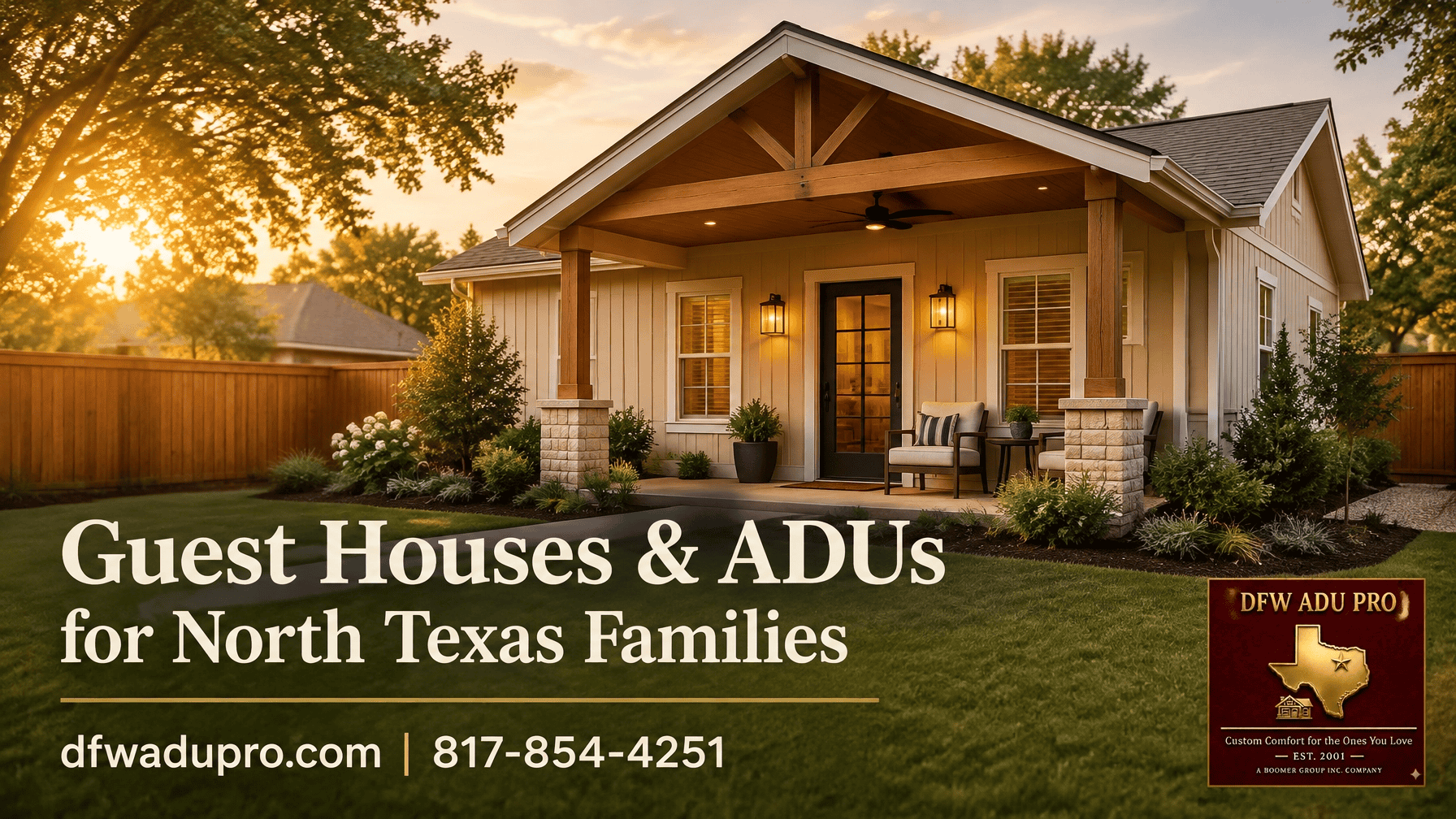
- Seamless Architectural Matching: We specialize in exterior finishes that mirror your main home's aesthetic: featuring premium Hardie siding combinations (such as board and batten with horizontal lap siding) in warm earth tones like tan, beige, warm gray, cream, and sage green.
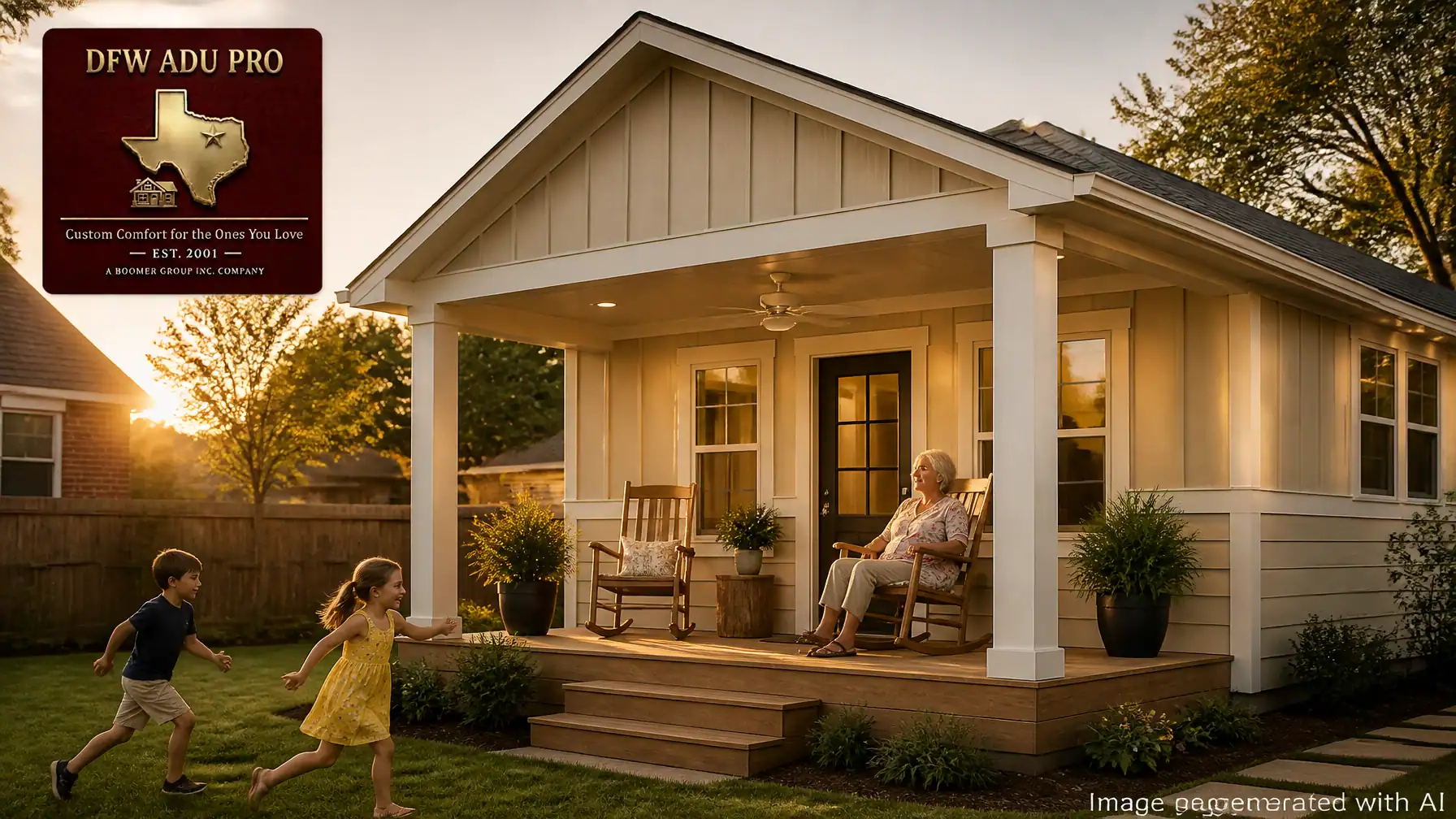
- Texas-Engineered Comfort: We design functional covered front porches built to beat the Texas heat, complete with robust framing, ceiling fans, and comfortable outdoor living spaces where grandma can watch the kids play in the yard.
Our Turnkey Approach: From Zoning Check to Final Walkthrough
Navigating municipal bureaucracies shouldn't be a second job for homeowners. That is why DFW ADU Pro provides a completely turn-key solution:
- Lot Feasibility & Zoning Audit: We evaluate your property in Keller, Southlake, Fort Worth, or surrounding Tarrant County neighborhoods to determine exactly what your zoning allows.
- Custom Design & Engineering: We craft floor plans tailored to your family's lifestyle: whether you need an ADA-accessible in-law suite or a spacious multi-room backyard cottage.
- Full Permit Management: We handle all city submittals, architectural plan checks, and contractor licensing requirements.
- Master Craftsmanship & Build: Our expert construction crews manage everything from the first pour of concrete to the final interior finish.

Ready to Explore Your Backyard's Potential?
Whether you are looking to build a comfortable guest house for aging parents or expand your property's living space without leaving your neighborhood, DFW ADU Pro is your trusted local partner. We combine deep North Texas roots dating back to 2001 with top-tier construction standards to make the entire journey effortless.
Contact our team today to schedule your initial lot evaluation and zoning review!

A division of Boomer Group Inc.
Leave a Reply